You like a room. You save the photo. Three weeks later you are standing in a furniture store trying to explain "warm but not country, clean but not cold" to a salesperson who is nodding politely. That gap — between liking a look and being able to name it — is what this guide closes.
We cover 15 interior design styles, the mix-ups that trip almost everyone (modern versus contemporary is the classic), a quick way to work out which style actually fits you, and how to test a style on your own floor plan before buying a single chair. People spend roughly 90% of their time indoors, according to the EPA figure cited by the American Society of Interior Designers — whatever style you land on, you will live inside it a lot. Worth choosing deliberately.
What Is an Interior Design Style?
A style is a recognizable set of choices: materials, colors, furniture shapes, and how much stuff is on display, repeated consistently enough that a room reads as one idea.
The professional distinction matters more than the dictionary one. As the American Society of Interior Designers puts it, interior design "supports the human experience through the functionality, materiality, safety and building codes" of a space — decoration is the layer you see, design is the layer you live with. Styles sit on top of that foundation; they never replace it.
How to Find Your Interior Design Style
Skip the quiz-then-identity trap. Style is not a personality type you discover; it is a direction you pick and refine. Our advice, from building design tools for exactly this decision: keep two or three candidate styles in play, test them against your actual floor plan, and only then commit. People who hunt for The One Style tend to freeze; people who test two styles make decisions.
Five questions narrow it faster than an afternoon of scrolling:
- Look at your saved photos. What repeats — the colors, the furniture shapes, or the clutter level? The repeat is the signal. If every saved room is white walls with one loud chair, you like minimalism with an anchor piece, not "eclectic."
- Do you want the room calm or lively? Calm points to Scandinavian, Japandi, minimalist. Lively points to bohemian, Art Deco, eclectic-leaning transitional.
- How much maintenance will you actually do? Honest answer, not aspirational. High-touch styles (biophilic with dozens of plants, bohemian layers) punish non-maintainers.
- What does your building give you? A 1970s apartment and a new build push toward different choices — you can fight the architecture, but it costs.
- What is your budget for texture? Some styles are cheap to fake (industrial, minimalist) and some are not (Mediterranean, Art Deco).
Answer those and you will usually land on two candidates from the list below. Good. Now read what each actually demands.
The 15 Interior Design Styles to Know
Grouped by what they ask of you, not by alphabet. Each style gets: what it is, its key elements, and a way to try it.
Modern & Contemporary Styles
Modern. A specific historical movement, not a synonym for "current" — modern interior design grew out of the late 19th century and matured through the first half of the 20th, rejecting the ornate interiors before it. Decorilla's guide traces it to "a sleek and uncluttered style that began in the late 19th century," built on clean lines and honesty about materials. Key elements: flat or low-profile furniture, natural and industrial materials, block colors, near-zero ornament, function deciding form. Try it if: you hate dusting and love storage.
Contemporary. Whatever is being made now — which is exactly why it confuses people. As Decorilla notes, contemporary and modern get used interchangeably, but "they are two distinct design styles from different periods," and contemporary is still forming; in time it will freeze into something we look back on. Today's contemporary means soft curves, mixed natural textures, muted palettes with one anchoring tone. Key elements: rounded furniture silhouettes, layered neutral fabrics, sculptural lighting, negative space used deliberately. Try it if: you want current without chasing trends yearly.
Mid-Century Modern. The 1950s-and-60s slice of modernism, and the reason your parents' teak sideboard is expensive again. Tapered legs, organic curves, walnut and teak, colors like mustard and olive used sparingly. It photographs beautifully and forgives small rooms, which is why it never really left. Try it if: your space is small and you want furniture that earns its footprint.
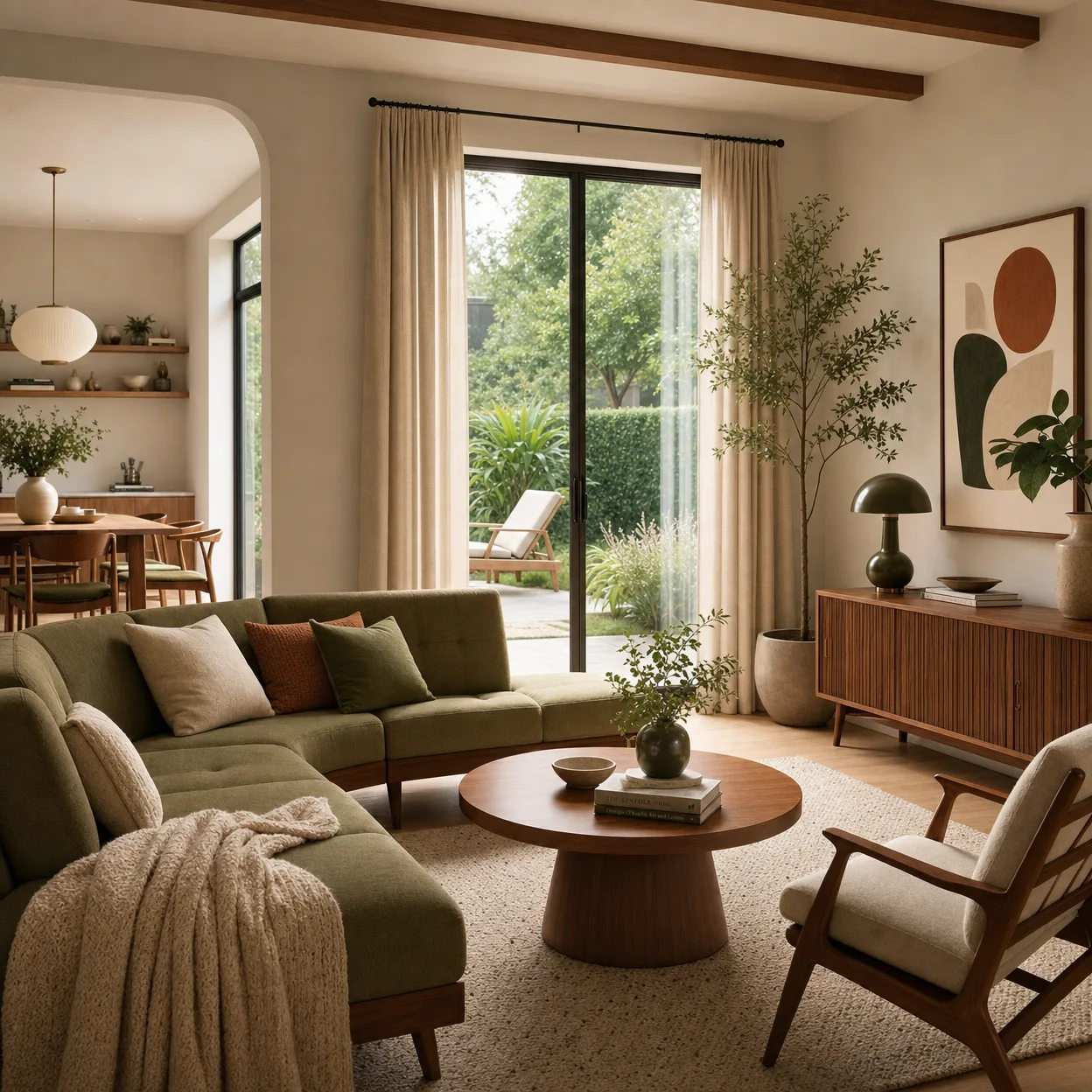
Minimalist. Modernism's strictest grandchild. Everything visible earns its place; storage does the heavy lifting; palette stays to two or three tones. The failure mode is well known — rooms that look like nobody lives there, then collapse into clutter within a month. Minimalism works when your storage plan is brutal and honest. Try it if: you own fewer things than your friends and like it that way.
Warm & Classic Styles
Traditional. European inheritance: symmetry, crown molding, dark woods, upholstered everything, rooms built around a fireplace or a view axis. It is the style real-estate listings mean when they say "timeless." Heavy on trim work, so it rewards buildings that already have some — for the style at full scale, see our guide to mansion floor plans. Key elements: paired furniture, rich fabrics, antiques or reproductions, layered window treatments. Try it if: your home has original detail worth amplifying rather than hiding.
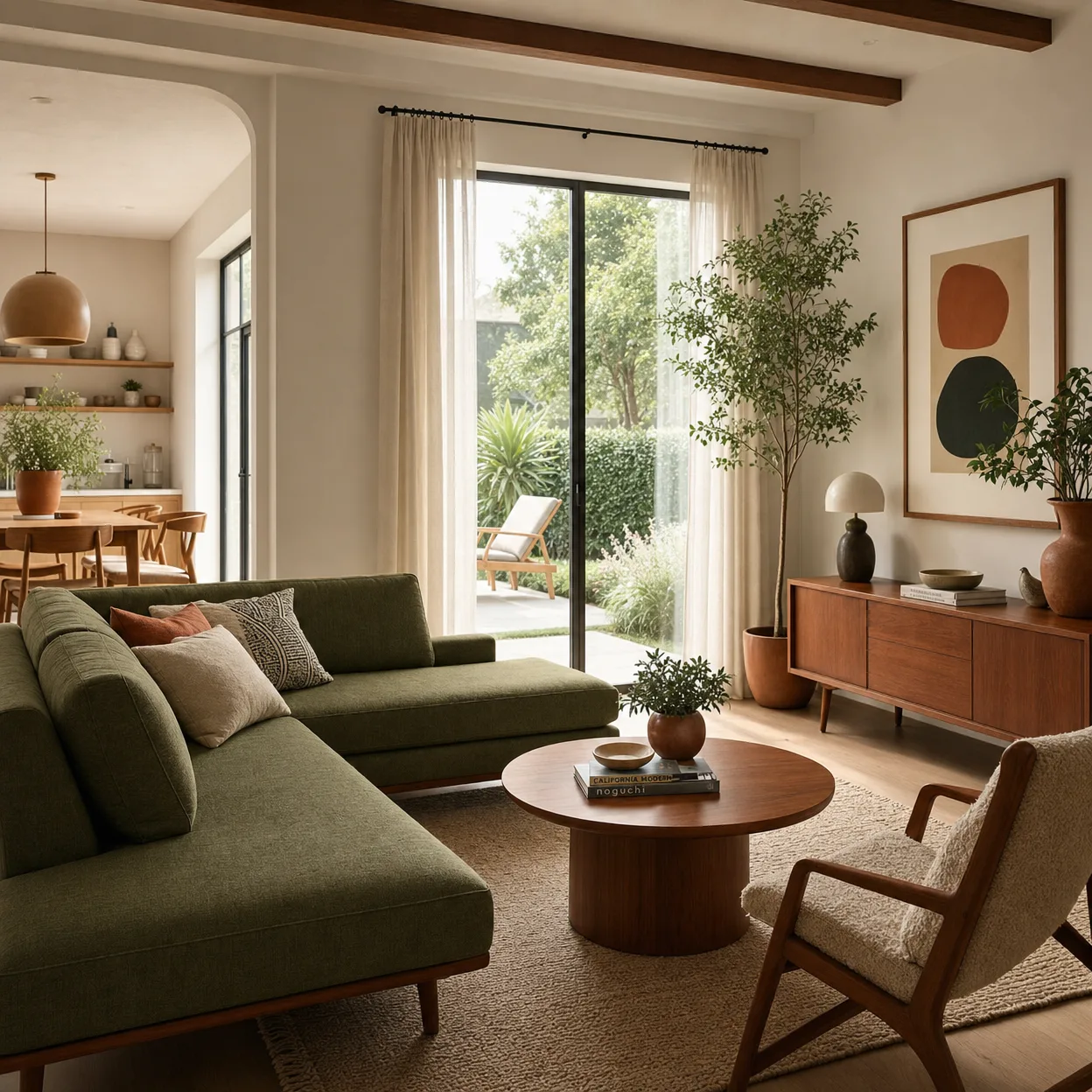
Transitional. Traditional's negotiation with the 21st century. Keep the comfort and symmetry, drop the ornament; swap claw feet for clean-lined upholstery in greige and navy. It is the most rented-looking style on Airbnb for a reason — nearly nobody hates it. Try it if: you share a home with someone whose taste disagrees with yours.
Scandinavian. Function-first, light-obsessed, wood-heavy, born from Nordic winters that make daylight a material. Industry interest is not fading — Archiproducts' 2026 styles guide (updated July 2026) notes Scandinavian furniture "continues to dominate" the most-wanted list. Key elements: pale woods, white walls as light amplifiers, wool and linen, hygge-adjacent coziness without clutter. Try it if: your rooms are north-facing or small-windowed.
Japandi. Japanese restraint meets Nordic warmth, and the two travel well — the BBC's piece on Japandi's rise traces the connection back to the 1950s and quotes buyer Kris Manalo on the formula: Scandi hygge (coziness) plus Japanese wabi-sabi (beauty in imperfection) equals "a stress-free atmosphere." Key elements: low furniture, paper and linen textures, muted earth tones, one imperfect handmade object per sightline. Try it if: minimalism appeals but feels too cold.
Rustic & Natural Styles
Farmhouse. Working-rural vocabulary — shiplap, apron sinks, open shelving, reclaimed wood — popularized far beyond farms. The 2026 version is less "distressed everything," more modern farmhouse: cleaner lines, real wood, fewer chalk-painted props. Flooring matters disproportionately here; our vinyl plank flooring guide covers the practical options. Try it if: you want warmth that survives kids and dogs.
Industrial. Warehouse bones exposed: brick, concrete, blackened steel, visible ducts, leather that ages. The trick is warmth management — all hard surfaces reads as a gym. Add one oversized soft element (a deep sofa, a heavy rug) and it becomes livable. Cheap to fake, which is both its charm and its trap. Try it if: your building already has brick, concrete, or big windows worth showing off.
Biophilic. Design that treats connection to nature as a requirement, not a decor accent. The name has real intellectual history — biologist Edward O. Wilson popularized biophilia in his 1984 book, building on Erich Fromm's earlier use of the term, and Britannica summarizes the hypothesis as humans having "an inherent need to connect with nature." In rooms that means daylight-first layouts, actual plants (plural), natural fibers, and views prioritized over art. Try it if: you feel measurably better in a plant shop than in a showroom.
Expressive & Global Styles
Bohemian. Collected, not bought. Layered textiles, plants, travel finds, zero interest in matching sets. The gap between good bohemian and clutter is curation — every shelf has a reason. Try it if: your favorite objects are souvenirs, not purchases.
Coastal. Not "nautical" — no rope-wrapped lamps required. The real thing is light (sheer everything), washed woods, whites and sea-glass blues, rooms that assume sandy feet sometimes. Try it if: you live near water or wish you did.
Art Deco. The 1920s-and-30s glamour movement. Britannica dates it precisely: "a design style of the 1920s and '30s characterized especially by sleek geometric or stylized forms," maturing at Paris's 1925 Exposition Internationale before conquering America in the 1930s. Think symmetrical drama — brass, velvet, sunburst mirrors, black-and-gold geometry. It is the most expensive style on this list to do authentically. Try it if: your building has a lobby that already hints at the era.
Mediterranean. Sun-baked and unbothered: terracotta, whitewash, arched openings, wrought iron, tiles that tell you the weather outside. In cold climates it fights the seasons, so commit to textiles to keep it habitable year-round. Try it if: your space has strong natural light and you cook for groups.
How to Test Any Style with an AI Home Design Tool
Reading about styles gets you 60% of the way. The last 40% is seeing the style on your walls, with your room's proportions — and this is the part no amount of photo-browsing solves.
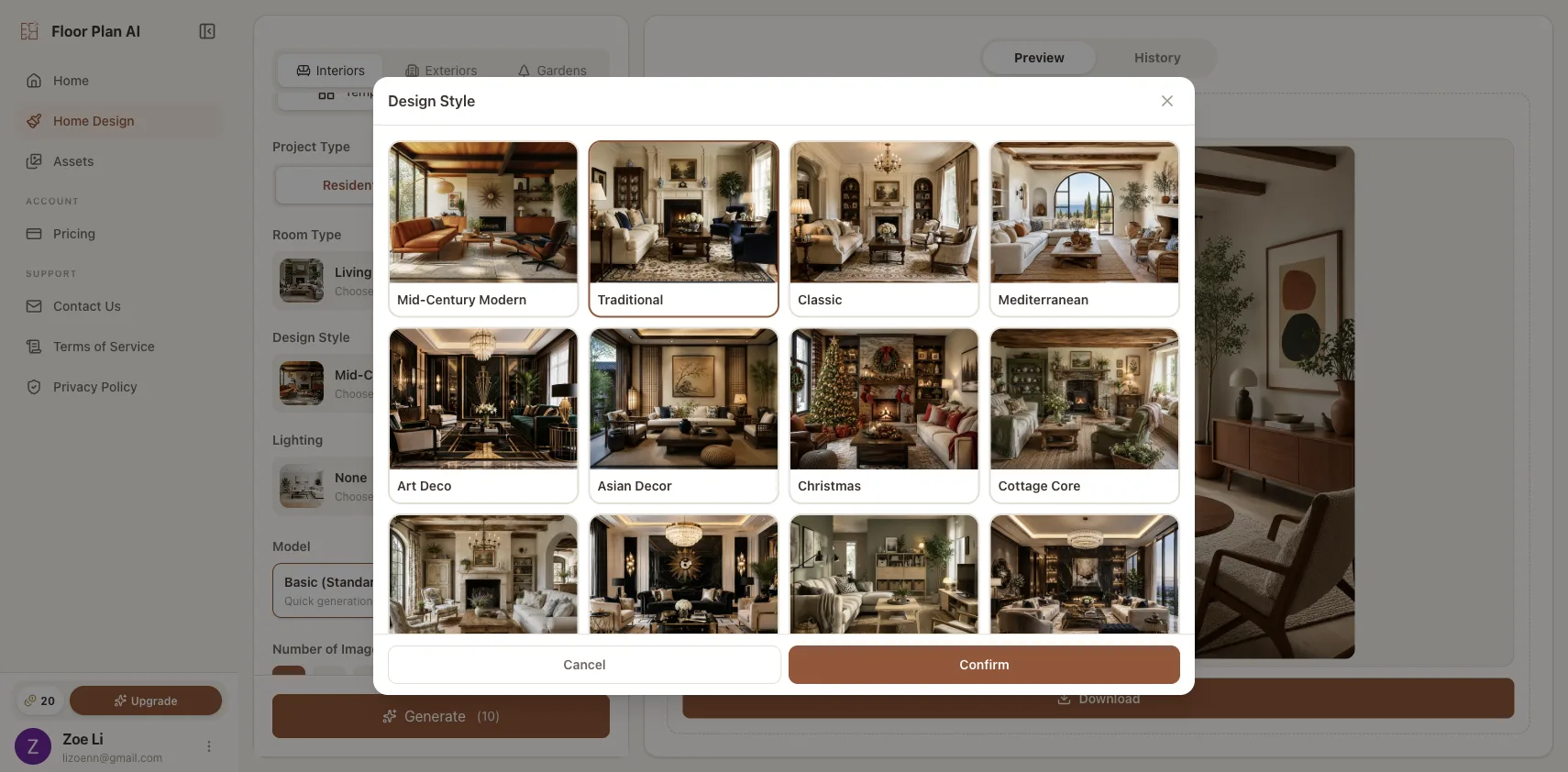
Three steps, and the tooling is free:
- Get your room into the tool. Sketch it in our free floor plan creator — walls, windows, doors. Five minutes for a rectangular room; the proportions are what matter, not millimeter accuracy. (If you have never drawn a plan, how to draw a floor plan to scale walks the basics.)
- Generate the look. Upload or select the plan in our AI home design generator, pick a style — then pick a second style. Comparing two outputs of the same room is what makes the differences legible. Scandinavian and Japandi on the same floor plan teach you more than ten articles.
- Judge against the five questions, not the prettiness. Every render looks good. Ask instead: can I maintain this? Does the furniture footprint fit how we actually move through the room? Would I still like it in February?
The two living-room renders in this guide came from exactly this workflow — one room photo, Mid-Century Modern first, then Traditional. Notice what stayed put: the walls, the window, the room's proportions. Notice what moved: everything else. That is the tool doing its job, and it is why the renders will not be perfect. They do not need to be — you are testing direction, not ordering furniture from the image.
Modern vs Contemporary: Styles People Mix Up
The confusion exists because both styles favor clean lines and neither is fussy. The difference is time. Modern is a fixed historical movement with rules (a specific era's reaction against ornament); contemporary is a moving snapshot of the present that will itself freeze into a named period someday. A useful tell: modern rooms from 1955 look recognizably "mid-century" today, while contemporary rooms from 2015 already look slightly dated.
| Modern | Contemporary | |
|---|---|---|
| Period | Late 19th c. – mid 20th c., fixed | Present day, moving |
| Palette | Block colors, primaries | Muted neutrals, one anchor tone |
| Lines | Straight, functionalist | Softer curves, organic shapes |
| Materials | Wood, steel, honesty about structure | Mixed naturals: bouclé, stone, light woods |
Traditional vs Transitional. Traditional follows historical formulas (symmetry, molding, matched sets); transitional keeps the comfort and quietly deletes the formulas. If a room has a wingback chair and a bouclé sofa and it works, that is transitional doing its job.
Minimalist vs Scandinavian. Both are restrained. Minimalist is a philosophy of subtraction — count objects; Scandinavian is a response to darkness — count light sources and textiles. A Scandinavian room is warm-first with clutter-control; a minimalist room is empty-first with warmth-control.
Interior Design Styles by Room
The same style lands differently depending on the room's job. A matrix beats a lecture here:
| Style | Living room | Bedroom | Kitchen |
|---|---|---|---|
| Scandinavian | Seating near windows, pale wood floors | Layered linens, one warm lamp cluster | White cabinets, open shelves, wood counters |
| Industrial | Exposed brick + one oversized sofa | Softer textiles mandatory or it reads cold | Steel + wood mix, open ductwork embraced |
| Japandi | Low-profile seating, floor-level table | Platform bed, paper lamp, nothing on walls but one print | Handleless cabinets, warm wood, stone sink |
| Farmhouse | Big soft sectionals, wood beams | Quilts, iron bed frames, muted paint | Apron sink, shaker cabinets, open shelving |
| Art Deco | Velvet seating, brass accents, mirrored furniture | Upholstered headboard, sconce lighting | Geometry in tile, brass hardware, dark cabinets |
Rule of thumb: carrying one style through the whole home is a choice, not an obligation. Shared spaces take the style you want to live in; bedrooms can drift one notch calmer without breaking anything.
Interior Design Styles FAQ
What are the main types of interior design styles?
Searches often mention "7 types" — the usual core seven are modern, contemporary, traditional, transitional, minimalist, Scandinavian, and industrial. Fifteen is a safer survey once you count the hybrids people actually live with (Japandi is literally two styles fused). Our list above covers the seven plus the eight most requested.
What is the most popular interior design style in 2026?
Scandinavian holds its lead — Archiproducts' styles guide, updated July 2026, says Scandinavian furniture "continues to dominate" the most-sought list. But House Beautiful's 2026 trends piece, drawing on designers, argues the year is less about one look than "a shared sensibility": softer forms, layered materials, rooms that feel collected rather than curated. Read those together and the honest answer is: warm, personal, texture-heavy rooms — whichever named style gets you there.
How do I know which interior design style suits me?
Run the five questions in the "find your style" section above against your saved photos. Then test the top two candidates on your own floor plan before buying anything.
Can you mix interior design styles?
Yes, with a discipline: mix by layer, not by half-room. Keep architecture, big furniture, and palette consistent; vary textiles, lighting, and accessories. That is how transitional and Japandi exist at all.
Why does my room look wrong even though I copied the right style?
Usually one of three things: the furniture scale is off (the most common — copying a style's palette without its proportions), the lighting is single-source and flat, or the room fights its architecture. Fix the last one first; nothing survives a bad layout.
What is the easiest style to pull off on a budget?
Industrial or minimalist — both lean on what buildings already have and forgive inexpensive furniture. The expensive part of both is not the furniture, it is the storage that keeps them looking intentional. Budget for the storage.
Naming your style is worth an afternoon, not an identity crisis. Pick two candidates, generate them on your actual floor plan, and see which room you want to walk into on a tired Tuesday — if you want to run that test yourself, the AI home design generator is free, and so is drawing the plan it needs.